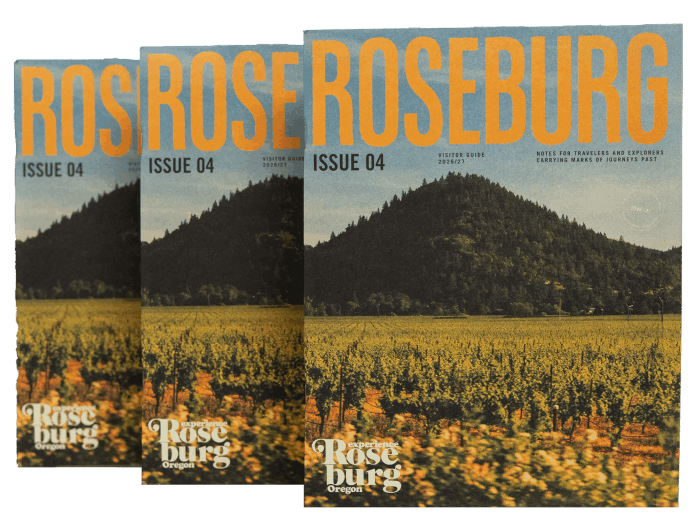
Roseburg is the county seat of Douglas County and the medical and commercial hub of southern Oregon's Umpqua River Valley. The North and South Umpqua Rivers join at River Forks just west of town and flow toward the Pacific Coast. Roseburg is positioned along the I-5 corridor about 70 miles south of Eugene and 180 miles south of Portland, with the Cascade Mountains rising to the east and the Coastal Range standing between the city and the ocean to the west.
Locals describe Roseburg as a green belt that rarely freezes and rarely gets above 100 degrees. The town is organized into four quadrants and most residential neighborhoods sit within 12 to 15 minutes of Mercy Medical Center, which is one of the features physicians and their families consistently call out.
Roseburg sits in a wide river valley between two mountain ranges. The Callahan Range to the west acts as a coastal weather buffer, dropping most of the rain before it reaches town. The Cascades to the east give residents direct access to Diamond Lake, Crater Lake, and the Umpqua National Forest. The South Umpqua, the North Umpqua, and the main Umpqua River shape the layout of the city and the surrounding neighborhoods, with riverfront property available along all three.
The Roseburg trade area includes the smaller surrounding towns of Sutherlin (~8,700 residents), Winston (~5,700), Reedsport (~4,300), Myrtle Creek (~3,500), and the rural community of Glide. Together, the Roseburg metro footprint is roughly 40,000 residents, with a total service area near 105,000.
Roseburg has four mild seasons. Summers run dry from June through mid-September with consistent sunshine and warm afternoons. Fall and winter bring rain that turns the valley deep green by early spring. Snow at valley elevation is uncommon, though winter dustings occur on the surrounding hills. The valley averages noticeably more sunny days each year than Portland and a milder winter than Bend or Medford.
| Climate Metric | Value |
|---|---|
| Average Summer High | Low to mid 80s°F |
| Average Winter Low | Mid 30s°F |
| Annual Rainfall | ~33 inches |
| Snowfall (Valley Floor) | Light, occasional dustings |
| Sunny Days per Year | ~150+ |
| Destination | Distance | Approximate Drive Time |
|---|---|---|
| Eugene, OR | 70 miles | 1 hour |
| Eugene Airport (EUG) | 75 miles | 1 hour 15 minutes |
| Pacific Coast (Reedsport) | 75 miles | 1.5 hours |
| Diamond Lake | 80 miles | 1.5 hours |
| Crater Lake National Park | 85 miles | 2 hours |
| Medford, OR | 95 miles | 1.5 hours |
| Portland, OR | 180 miles | 3 hours |
| Bend, OR | 165 miles | 3 hours |
Timber and healthcare are the primary employers in Douglas County. Roseburg Forest Products, headquartered locally, operates across five states and two countries and remains an international supplier of wood products. Mercy Medical Center and VA Roseburg Healthcare System anchor the medical sector. The valley also supports more than 30 wineries, a growing craft beverage scene, and a sizable agricultural base.
Major industries include:
Roseburg has the character of a family-focused, outdoor-oriented small city. The community is tight-knit, generations often return after college, and the surrounding rural land supports horses, livestock, and acreage living for those who want it. Physicians who land well here tend to value a slower pace, river and mountain access, and the chance to be a recognized member of the community rather than an anonymous member of a large metro group.
Roseburg sits in a useful spot for physicians who want both rural quality of life and access to bigger-city amenities. Eugene, with the University of Oregon, a regional airport, and broader cultural and shopping options, is one hour north. Portland and Bend are reachable for a weekend trip. The Oregon coast, Crater Lake, and Diamond Lake are all within a 1.5 to 2 hour drive.
Looking to explore a new destination, but not sure where to start? A travel guide can help you discover the hidden gems and must-see attractions of a new place. Whether you're looking for the best local cuisine, the most scenic views, or the most exciting activities, a good travel guide can provide you with insider knowledge and expert recommendations. With a travel guide in hand, you can make the most of your trip and experience a new place like a local. So why not start planning your next adventure with a travel guide today?
Roseburg has been the political, commercial, and cultural center of southern Oregon's Umpqua Valley since the 1850s. The city grew from a single homestead on the Oregon-California Trail into the timber capital of the Pacific Northwest and, more recently, into a healthcare and tourism hub for Douglas County.
The land that became Roseburg was originally home to the Cow Creek Band of the Umpqua Tribe and other southern Oregon Indigenous groups. In 1841, the Wilkes United States Exploring Expedition passed through the area on its way from the Columbia River to San Francisco Bay.
Pioneer Aaron Rose, originally from New York, settled at the confluence of Deer Creek and the South Umpqua River on September 23, 1851. Rose built a tavern and stopping place for travelers on the Oregon-California Trail. His homestead formed the nucleus of the settlement, then called Deer Creek. A post office opened the following year.
In 1854, an election moved the Douglas County seat from the rival town of Winchester to Rose's settlement. Aaron Rose donated 3 acres of land and $1,000 toward the construction of the county courthouse. Key buildings from Winchester were physically relocated to Roseburg before 1860. The town was officially renamed Roseburgh in 1857 in honor of its founder, then shortened to Roseburg in 1894.
The Southern Pacific Railroad reached the city in 1872, the same year Roseburg was formally incorporated. Aaron Rose donated land for the rail line, which positioned Roseburg as the southern terminus and trade center for the Umpqua Valley.
| Year | Event |
|---|---|
| 1851 | Aaron Rose settles at Deer Creek |
| 1854 | Roseburg named Douglas County seat |
| 1857 | Town officially renamed Roseburgh |
| 1872 | Railroad arrives; town incorporated as Roseburg |
| 1894 | Spelling shortened to Roseburg |
| 1936 | Kenneth Ford founds Roseburg Lumber |
| 1959 | Roseburg Blast reshapes downtown |
| 1964 | Umpqua Community College established |
| 2021 | Healthcare becomes the largest employment sector |
The Umpqua Valley's surrounding forests defined Roseburg's economy for more than a century. Sawmills, brickyards, breweries, canneries, and woodworking shops all came and went, but timber remained the constant. Kenneth Ford founded Roseburg Lumber in 1936, which grew into Roseburg Forest Products and is still privately held by the Ford family today. The company now operates mills across five states and two countries and remains one of the largest employers in the region.
By the 1970s, Roseburg carried the nickname Timber Capital of the Nation. Country singer Johnny Cash referenced the town's loggers in his 1960 song Lumberjack. Roseburg Forest Products and Douglas County Forest Products continue to anchor the local timber industry, with several mills running 24-hour operations.
On August 7, 1959, a parked truck carrying explosives caught fire and detonated in downtown Roseburg, killing 14 people, injuring more than 125, and causing $10 to 12 million in damage. The event led to federal changes in how hazardous materials are transported through populated areas. Much of downtown was rebuilt in the years that followed, and locals still refer to the event simply as "the Blast."
The Northwest timber downturn that began in the 1980s hit Douglas County hard, and Roseburg spent decades working to broaden its economic base. The community made significant investments in healthcare, higher education, wine production, and tourism. Umpqua Community College opened in 1964 and now houses the Southern Oregon Wine Institute. The Veterans Administration Roseburg Healthcare System grew into a 114-acre campus serving veterans across Oregon and Northern California. Mercy Medical Center expanded into the region's primary acute-care hospital.
By 2021, healthcare and healthcare support services had passed timber as Douglas County's largest employment sector. Roseburg Forest Products remains the largest single employer, with Mercy Medical Center close behind.
Roseburg is a small city by national standards but functions as the primary population center for Douglas County's roughly 112,000 residents. The Roseburg micropolitan area combines the city itself with the surrounding towns of Sutherlin, Winston, Myrtle Creek, Reedsport, and Glide. Mercy Medical Center's service area extends across this footprint and totals about 105,000 people. Growth is slow and steady, with the city adding less than 1% per year since the 2020 census.
| Metric | Roseburg (City) | Douglas County |
|---|---|---|
| Population (2025 est.) | ~24,000 | ~112,000 |
| Annual Growth Rate | 0.13% | 0.13% |
| Median Age | 39.6 years | ~46 years |
| Median Household Income | $53,918 | $58,000 |
| Per Capita Income | $41,460 | $34,000 |
| Bachelor's Degree or Higher | ~19% | ~18% |
| Unemployment Rate | 5.2% | 5.4% |
| Average Commute Time | 18 minutes | 22 minutes |
Roseburg skews slightly older than the U.S. average due in part to the VA Roseburg Healthcare System, which draws retired veterans to the area. The city itself has a younger median age than the county overall because of the higher concentration of working families and college students. Roughly 27% of city residents are seniors. About 41% of households have children under 18, giving the community a strong family base alongside its older population.
Roseburg is predominantly White, with smaller Hispanic, Native American, Asian, and multiracial populations. The Cow Creek Band of the Umpqua Tribe is headquartered in the region and operates the Cow Creek Umpqua Indian Foundation, Seven Feathers Casino Resort in Canyonville, and a range of healthcare and economic-development initiatives.
| Race/Ethnicity | Roseburg (Approx.) |
|---|---|
| White | 84.7% |
| Hispanic or Latino | 7.5% |
| Two or More Races | 5.0% |
| Native American | 1.5% |
| Asian | 1.2% |
| Black or African American | 0.5% |
| Other | 3.7% |
Healthcare overtook timber as the top employment sector for Douglas County in 2021. Retail, manufacturing, and education round out the largest sectors within the city of Roseburg itself. The county's overall employment base is broader, with significant timber, forest products, and agriculture workforces outside the city limits.
Top regional employers include:
The largest employment sectors for Roseburg residents (by share of workforce):
Roseburg's median household income is below the Oregon state median, reflecting both the cost-of-living gap with the Portland and Eugene metros and the predominance of timber, retail, and service-sector employment in the local economy. Income distribution is wider than the median suggests: roughly 21% of households earn under $25,000, while 8% earn over $150,000. Physicians, mill owners, and senior administrators sit at the upper end of the local income range.
Median income by household age range:
About 19% of Roseburg adults hold a bachelor's degree or higher, lower than the Oregon state average of about 37%. The community has a strong vocational and trades workforce alongside its healthcare professionals. Umpqua Community College serves as the primary postsecondary institution and produces nursing, allied health, viticulture, and skilled-trade graduates each year. Many Roseburg residents complete four-year and graduate degrees at the University of Oregon in Eugene or Oregon State University in Corvallis.
Locals describe Roseburg as family-focused and tight-knit, with multiple generations often staying in the area or returning after college. The community supports a steady mix of working families, retirees, agricultural and trades professionals, and a growing healthcare workforce. Physicians who land well in Roseburg generally connect with patients across this full economic and cultural range. A typical clinic schedule will include retired veterans, mill workers, school district staff, ranch and farm families, and the children of multi-generational Roseburg households.